Conversational AI is a category, not a widget.
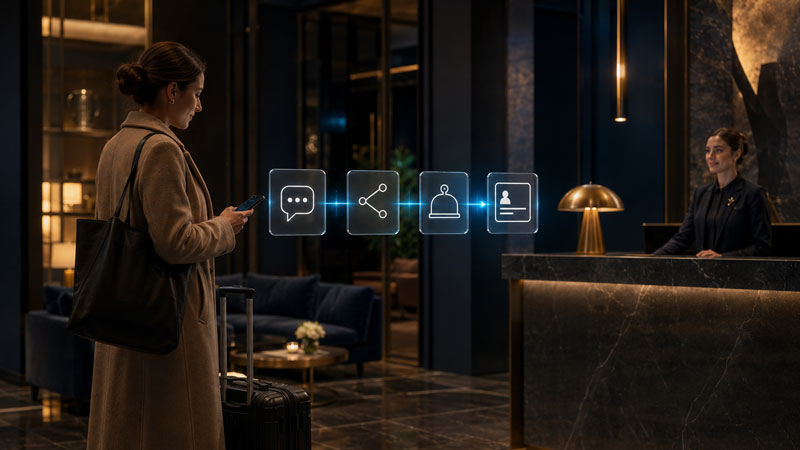
A hotel with a chat bubble on its website often assumes it has bought conversational AI. It has bought one surface. The category is wider and mostly invisible: which channel the guest chose to start on, whether the system understood what was actually being asked, what it is permitted to say, and what happens at the moment it should stop talking.
Those parts can be strong or weak independently, which is why two hotels running the same product can have entirely different experiences of it. A polished widget with a thin knowledge base produces confident nonsense. An excellent knowledge base behind a handover that lands in an unwatched inbox produces a guest who waited nine hours for nothing. The product is rarely the variable that matters most.
It is worth mapping the parts on paper before a demonstration, because a demonstration only ever shows the surface.
| Part | What it decides | What goes wrong when it is weak |
|---|---|---|
| Channel | Where the guest starts and what the hotel may send back | Messages land in an app nobody has open |
| Understanding | What the guest actually asked for | A confident answer to a question nobody asked |
| Knowledge | What the system is allowed to say | Plausible invention wherever the hotel never wrote a rule |
| Handover | When a person takes over and what they receive | The guest repeats the whole story to a member of staff |
| Memory | What carries between messages and between stays | A returning guest treated as a stranger, or a stranger greeted by name |
| Record | What is kept afterwards, and for how long | No evidence of what was promised in the hotel’s name |
An AI concierge promises more than most products deliver.
A human concierge does three things. They know the guest, they know the city, and they act on the guest’s behalf: the table is booked, the car is arranged, the quiet side of the building is remembered without being asked for again.
Most software sold as an AI concierge does a version of the second. It answers questions about the property and the area from information the hotel supplied. Knowing the guest requires a reliable identity and a stay history, which usually sits in a different system. Acting on the guest’s behalf requires permission to change something, which most implementations sensibly do not grant.
This is not a complaint about the software. It is how to scope it. When a proposal uses the word concierge, ask which of the three jobs it performs, what it needs in order to perform them, and what it does when that information is missing. The answers turn a category name back into a specification you can hold a supplier to.
Go deeperAI chatbot for hotelsSee how the website chat surface itself is put together, what it answers from and where its scope stops.
↗The channel changes the design more than the model does.
Website chat is anonymous, immediate and disposable. The guest is a session; when the tab closes, the conversation usually ends with it. That suits pre-booking questions and suits very little else.
Messaging behaves in the opposite way, and it carries rules the hotel has to design around. On the WhatsApp Business Platform a 24-hour customer service window opens when the guest messages the business, and it resets each time they message again. Once that window closes, only pre-approved template messages may be sent. A pre-arrival note is therefore not something reception composes on the day; it is a template registered and approved in advance. A thoughtful reply drafted twenty-six hours after the guest wrote will not send in the form it was written.
Social channels add a different problem. The person messaging is frequently not the person on the reservation—a partner, a colleague or an adult child asking about somebody else’s booking is an ordinary occurrence and an identity question the system has to be told how to handle.
The channel also decides whether the guest can use it at all. A website widget is part of the hotel’s own site and is judged by the same standard as the rest of it. WCAG 2.2 is the current W3C Recommendation; a chat panel that cannot be opened from the keyboard, or that becomes unreadable at 200% zoom, excludes some of the guests most likely to have a question worth answering.
Disclosure has to survive the channel too. The EU AI Act’s transparency provisions say people should be told when they are interacting with a machine, and the European Commission states that the transparency rules apply from August 2026. That is straightforward in a widget with a header. It is harder on WhatsApp, where there is no interface to put it in, and hardest by voice, where it has to be spoken before the caller loses patience.

| Channel | Who the guest is | Where it breaks |
|---|---|---|
| Website chat | Anonymous until they choose otherwise | The conversation ends when the browser tab closes |
| A phone number that persists between stays | Outside the 24-hour window only an approved template will send | |
| Instagram and Facebook | A social profile, often not the booker | The person messaging is not the person on the reservation |
| SMS | A phone number and nothing else | No images, no buttons, and a cost for every message |
| A named address, usually the booker | Threads split, and two people reply to the same enquiry | |
| Voice | Whoever picked up the telephone | Nothing can be scrolled back; a wrong figure is simply gone |
Intent recognition is the part that earns its keep.
Consider a single message: “Do you have anything for the 14th?” It has at least six plausible meanings—a room, a change to an existing reservation, a restaurant table, a treatment, a function room or a parking space. Which one it is depends on the channel it arrived on, the page the guest was reading and whether a booking already exists in their name.
A system that resolves that with one short question is genuinely useful. A system that guesses is worse than a contact form, because the guess arrives with the hotel’s name on it and sounds certain. The real design decision is where the confidence threshold sits: below it, the system asks; above it, the system answers. Disappointing implementations almost always have that threshold set too low.
A second example shows the other half of the problem. “Is the pool open?” can be answered from a facilities page. “Is the pool open on the 3rd?” cannot, because the answer depends on a maintenance schedule that in most independent hotels lives on a whiteboard behind reception. The limit there is not the model. It is that the hotel has no machine-readable answer to give it.
Classification is also the most under-used output of the whole category. If every conversation is tagged with an intent, the hotel ends up with a ranked list of what its own website fails to explain. Five weeks of guests asking where to leave bags before check-in is a page-content defect, and fixing the page is cheaper than answering it four hundred more times.

- The intents you will answer directly, with the approved source for each answer.
- The intents you will always route to a person, however confident the system is.
- The intents you will collect details for, then pass on without promising anything.
- The confidence level below which the system asks rather than answers.
- An intent recorded on every conversation, so the pattern can be read later.
- A monthly look at the intents that had no approved answer at all.
Write the handover rules before the launch date.
Four situations should end the automated part of a conversation: the guest asks for a person, the system’s confidence is low, the subject is on a list the hotel agreed never to automate, and the same question has already failed twice.
The fourth is the one most setups miss and the one guests remember. Being asked to rephrase for a third time is the moment somebody stops trying—not with the assistant, with the hotel. A counter is trivial to implement and is rarely present.
Handover is a transfer of responsibility, not a routing rule. Three things have to be defined: who receives it, what they receive, and what happens when nobody picks it up inside the time the guest was promised. The third is where implementations quietly fail. An escalation that arrives in a shared inbox at 23:40 has not been escalated to anybody.
| Trigger | What the system does | What the hotel must have ready |
|---|---|---|
| The guest asks for a person | Stops answering and states what happens next | A response time that is true at that hour |
| Confidence is low | Offers the handover instead of guessing | A monitored queue rather than a shared inbox |
| The subject is on the never list | Hands over without attempting an answer | An agreed list, written before launch |
| The same question failed twice | Hands over instead of asking again | A counter, and somebody who reads the failures weekly |
| Nobody picks it up in time | Tells the guest honestly that it is waiting | An out-of-hours rule with a named owner |
Answering in a language nobody on the team reads.
A model will answer a German enquiry in German whether or not the hotel’s knowledge base was written in German, and whether or not anybody on duty can check what was said. Two questions are being answered at once—is the fact correct, and is the German correct—and in practice only the first is ever reviewed.
The exposure sits in policy. A cancellation term, a deposit rule or a statement about accessibility is a commitment made in the hotel’s name. Translated on the fly at 23:00, it is a commitment nobody has read. The workable position is to translate the wrapping and not the rule: keep a short approved form of each material policy in every language you actually receive enquiries in, checked once by somebody who reads it, and let the model handle the conversation around it.
Then keep a readable record. If the team cannot read the transcripts, the non-English conversations become the ones nobody ever reviews—which is precisely the traffic operating with the least scrutiny. A translated view of the thread for the morning review is a small feature with a large effect.
- Approved wording for cancellation, deposit and payment terms.
- The fallback message used when there is no approved answer.
- The disclosure that the guest is speaking to an AI assistant.
- The out-of-hours promise, including the hour a person replies.
- Date, time and currency formats, which change meaning between markets.
- The sentence that hands the guest to a member of staff.
Most of the value arrives when nobody is on shift.
The honest commercial case for conversational AI in a small property is not deflection during the working day. Reception can answer a question at 14:00. It is the enquiry at 22:40 from somebody four time zones away that would otherwise be read at 09:00, by which point they have booked elsewhere.
That is measurable without buying anything. Count the enquiries arriving outside staffed hours, and the share of them that received a useful answer or left contact details rather than meeting a form. It is the one figure in this category that maps directly onto demand the hotel would not otherwise have seen.
It also sets the trap. Out of hours is exactly when handover has nobody to hand to. Decide in advance what the system says at 02:00, and make it true. “Someone will get back to you shortly” is a promise that breaks by 02:05 and costs more than saying nothing. “The reception team reads this from 07:00 and will reply then” is duller, accurate, and something a guest can plan around.
Time zones are the quieter half of the same problem. If the property’s rules are written in local time and the guest is nine hours ahead, today and tomorrow mean two different things inside one sentence. Anything the system says about a cut-off, a late arrival or a same-day cancellation should name the property’s time zone rather than assume it.

Voice is a different product with the same name.
Everything that makes text forgiving is absent on a telephone call. The caller cannot scroll back, so a wrong figure is simply wrong and gone. There is no interface to place a disclosure in, so it has to be spoken first, in a sentence short enough not to irritate. Silence carries meaning: a two-second pause that reads as thinking in chat reads as a dropped call on a phone.
People also interrupt. A voice system that cannot be spoken over mid-sentence will be hung up on, and the calls it loses are the impatient ones—which in a hotel are disproportionately the ones about tonight.
Voice earns its place on calls that are essentially routing, and on an overnight line at a property with no night porter. It struggles with anything the caller has to write down, with a name that needs spelling, with a booking reference mixing letters and digits, with an unfamiliar accent over background noise, and with payment of any kind.
- Read the spoken disclosure aloud and time it in seconds.
- Talk over the system mid-sentence and see whether it stops.
- Give a hard-to-spell surname at normal speaking speed.
- Read out a booking reference that mixes letters and digits.
- Call from a car, a bar and a station concourse.
- Transfer to a person, and listen to what that person hears first.
Where conversational AI genuinely fails.
Every category has a list of things it does badly, and a supplier who cannot produce one has not run enough live deployments. This is the list worth having in front of you during a demonstration.
| Situation | Why it fails | What to do instead |
|---|---|---|
| A policy the hotel never wrote down | There is nothing to retrieve, so the gap gets filled | Decide the rule first, then decide whether to automate it |
| Live availability and price | The answer is only as current as the source behind it | Open the booking journey rather than stating a figure in chat |
| Anything the guest is upset about | Speed is not what the guest is asking for | Hand over at the first sign, without attempting to calm it |
| Accessibility suitability | Individual needs do not match a facilities list | Give the facts, then offer a person to confirm the requirement |
| Group and event enquiries | The answer depends on the calendar and the margin | Capture a structured brief and stop there |
| The second half of a long thread | Earlier context is dropped and the guest repeats themselves | Cap the length and hand over before that point, not after |
Read the transcripts before widening the scope.
Containment rate—the share of conversations closed without a person—is the figure every supplier reports and the least useful one to optimise. It can be improved by making the assistant harder to escape, which is the opposite of what a hotel wants. Treat it as a description, never as a target.
A better routine takes half an hour a week and needs no reporting tool. Read ten conversations chosen deliberately rather than at random: three that were handed over, three the guest abandoned mid-thread, two the system answered with low confidence, and two in a language nobody on the team reads.
- Enquiries that arrived outside staffed hours, and what became of them.
- Questions that produced the fallback message, grouped by subject.
- Handovers not picked up inside the promised time.
- Conversations where the guest asked the same thing twice.
- Contact details captured that became a real enquiry.
Set ownership, response times and handover across the whole guest journey rather than one channel.
↗Transcripts are personal data the moment they are useful.
The reading routine above only exists because conversations are stored, and a stored conversation containing a name, a booking reference or a phone number is personal data. The ICO’s guidance on AI and data protection sets out the questions to settle before that record exists: the purpose it serves, the lawful basis, who inside the hotel can see it, which supplier holds it and how long it is kept.
Retention is the item most often left undecided, and it is a five-minute conversation before launch and an awkward one afterwards. A hotel that keeps every transcript indefinitely because nobody chose a period has made a decision by accident. Ninety days is a defensible answer; so is a year, if there is a reason behind it. Having no answer is not.
The purpose of all this reading is not to score the supplier. Every fallback message is either a page that fails to explain something or a decision the hotel has not made, and both are cheaper to fix than the software is to replace. Widen the assistant’s scope only when the current scope has stopped producing that list.
Scope a conversational AI setup in an hour
Work through this with the people who will actually answer the handovers. Anything you cannot answer is a decision to make, not a feature to buy.
checked
Current guidance behind this article
This guide combines primary guidance with practical hotel workflow analysis. Product capabilities and integrations should still be verified against the property’s systems, operating rules and current supplier documentation.
- European CommissionAI Act regulatory framework
Current risk-based framework, implementation timeline and chatbot transparency obligations.
- Meta for DevelopersSend messages and the customer service window
How the 24-hour WhatsApp customer service window opens, resets and closes, and what may be sent once it has.
- Information Commissioner’s OfficeArtificial intelligence and data protection
UK guidance, risk tools and explanation duties for organisations using personal data in AI systems.
- W3CWeb Content Accessibility Guidelines (WCAG) 2.2
The current W3C Recommendation for accessible web content across desktop and mobile.